LED Volume Studios: What Makes a Shoot Work
LED volume studios give teams finished-world visuals in camera. Learn what to plan, what to budget, and when a Dubai LED stage is the right choice now.
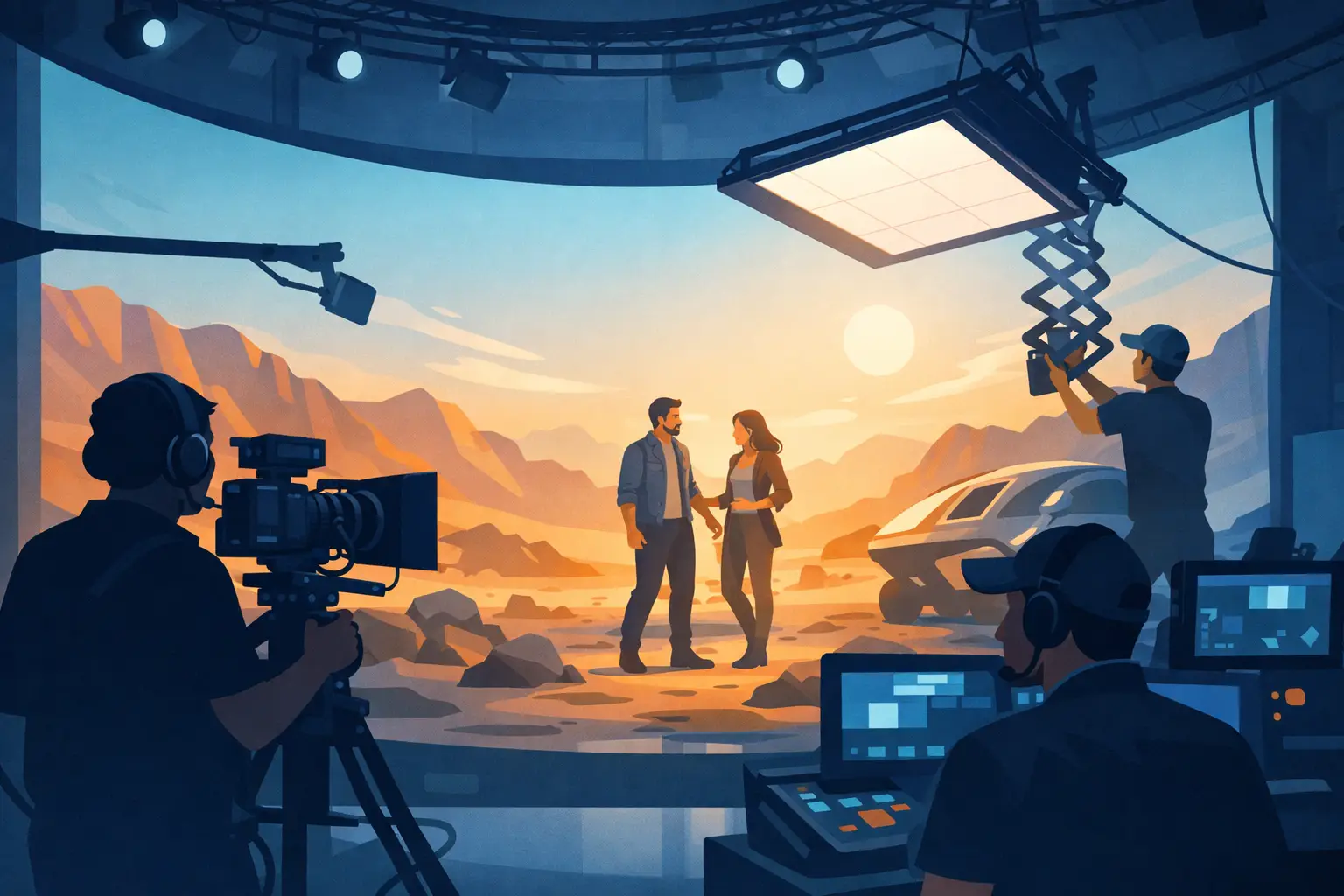
A location change can cost more than a studio day before the first camera rolls. Travel, permits, weather holds, company moves, and post-production compositing all add time to a shoot that still needs to produce content fast. LED volume studios offer a different route: put the environment behind the talent on a large LED wall, light the subject with the image itself, and capture a more finished frame in camera.
That does not mean every project needs an LED wall. It means teams that need control, speed, and a premium visual result have another production option - one that can make a campaign, keynote, product video, or month of social content far more efficient.
What LED volume studios actually do
An LED volume is a studio environment built around a high-resolution LED screen, often paired with a reflective or mirror floor, controlled lighting, sound, and enough open space for talent, cameras, and crew. The screen displays a visual background during the shoot: a city skyline, branded motion graphics, a stylized room, an abstract color world, or a presentation deck.
For film productions, the term can describe sophisticated real-time virtual production, where a 3D environment changes perspective as the camera moves. That workflow requires the right render engine, camera tracking, calibrated lenses, content preparation, and an experienced virtual production team.
For commercial content, social video, interviews, and speaker recordings, the value is often simpler and just as useful. The LED wall gives you an immediate, controlled background that is visible to the subject, camera operator, and client. You can change the visual direction in seconds without rebuilding a physical set or waiting for a green-screen composite.
The distinction matters when you are comparing quotes. Ask whether you need real-time tracked virtual production or a large-format LED backdrop for in-camera visuals. Both are valuable, but they are different production setups with different technical requirements and budgets.
Why the LED wall changes the production workflow
A standard studio gives you space. A green screen gives you flexibility in post. An LED stage gives you a visual decision point on set.
When the background is live, directors and clients can judge framing, wardrobe, contrast, and brand colors before the shoot is over. A presenter can react to a real visual instead of speaking to a blank wall. Reflections on glossy products, glasses, vehicles, or a mirror floor can feel more natural because the environment is physically present as light.
This can reduce revision cycles, but only if the screen content is prepared properly. A low-quality image, the wrong aspect ratio, poor brightness settings, or an untested color palette can quickly make an expensive screen look like a generic digital backdrop. The LED is not the creative idea. It is the production tool that makes a prepared idea faster to execute.
For brands producing short-form content, the biggest advantage is volume. One set, one lighting setup, and several screen looks can generate a wide range of Reels, ads, expert clips, product explainers, and announcement videos in a single session. Instead of spending four hours creating four nearly identical videos, a team can build distinct visual chapters without moving locations.
When an LED volume is the right choice
LED volume studios work best when the setting contributes directly to the message. A founder announcing a market expansion may need a premium, global visual environment. A speaker can use a branded presentation world behind them rather than standing beside a standard projector screen. A product launch can move from technical graphics to lifestyle imagery to campaign messaging without a set rebuild.
They are also a strong fit when content needs to be ready quickly. If the production is designed around a defined set of formats, the studio team can move directly from recording to edit selections, captions, and vertical exports. That is particularly useful for personal brands and marketing teams that need consistent publishing assets, not one hero film delivered weeks later.
An LED stage may not be the best choice for every job. Natural daylight scenes, highly detailed outdoor action, or a story built around extensive camera movement may require a location, a constructed set, or a full tracked virtual production pipeline. Green screen can still be the more economical option when backgrounds will be heavily changed in post and there is enough time for compositing.
The practical question is not, “Does this look futuristic?” It is, “Will this setup help us capture the right assets faster and with fewer production variables?”
Plan the screen content before the studio day
The LED wall is ready when you arrive. Your visual content should be ready too.
Start with the final deliverables. If you need vertical Reels, plan the background composition for a vertical crop rather than relying on a wide image that loses its key details on a phone screen. If you are recording a presentation, define where slides, titles, and speaker movement will sit in the frame. If your campaign needs several messages, create a clear sequence of screen scenes and the lines that belong to each one.
Treat every screen look as a set change. A clean gradient may be right for a founder message. A moving graphic can support a product demonstration. A city image can establish a location or business ambition. The visual should support the talent, not compete with them.
There are technical details to confirm before shoot day:
- Screen resolution and pixel pitch, especially for close camera framing
- Native screen dimensions, final camera aspect ratios, and safe areas for vertical crops
- File types, playback method, and whether animations need to loop
- Brightness, color calibration, and how wardrobe will respond to the screen light
- Whether the floor will reflect the content and whether that reflection is desired
- Camera distance and shutter settings that help prevent moiré or visible LED scan lines
These checks are not overproduction. They prevent the common problem of discovering that a great graphic does not work once it is photographed.
Build the shoot around formats, not vague coverage
A productive LED studio day starts with a shot plan that matches the publishing plan. For a business owner, that may mean 20 to 30 short talking-head clips, one campaign video, several cutaways, and a small set of portrait images. For a production company, it may mean a full crew call, a camera package, and a controlled visual environment for a commercial scene.
The workflow changes based on who is running production. Some teams want a prepared facility and complete control of their own director, camera crew, lighting choices, and client process. Others want a turnkey service that covers scripting, recording, editing, and delivery. Both models work when responsibilities are clear before call time.
At PROS.CRTV, the Dubai studio is designed for both approaches: a 90+ m² production space with an LED screen, mirror floor, lighting, sound, and room for crews of up to 20 people. For content-led sessions, the goal can be straightforward - turn one focused shoot into ready-to-publish Reels within 24 hours. For crews renting the space, the priority is a production-ready environment that does not slow down the schedule.
Budget for the full decision, not only the hourly rate
Studio rental is only one line in the production budget. An LED volume can reduce costs elsewhere, but it also creates its own requirements. Factor in screen content design, animation, a playback operator if needed, camera and lighting crew, talent preparation, editing, and any specialist virtual production support.
A simple branded-background shoot can be highly efficient. A photoreal, camera-tracked virtual environment is a different level of work. Neither option is automatically better. The right one depends on what the audience must believe when they see the final frame.
For a four-hour business-content session, a defined deliverable package often creates the clearest value: a planned number of videos, approved screen visuals, a recording schedule, and a delivery deadline. For a commercial production, an hourly studio rate may be appropriate, provided the team has allowed enough time for setup, LED tests, rehearsals, and resets.
The details that protect the final image
LED screens are bright, but more brightness is not always better. Overdriving the wall can affect skin tones, create unwanted spill, and reduce the sophistication of the image. Wardrobe deserves a camera test as well. Fine stripes, tight patterns, very reflective fabrics, and certain shades can behave unpredictably against LED pixels.
Sound also needs attention. A large studio with a hard floor and screen surface may require close microphone placement and deliberate audio monitoring. If a speaker is recording thought leadership or a corporate presentation, clean sound is not secondary. It is what makes a polished visual feel credible after the first few seconds.
Finally, leave time to review selects while the talent and set are still available. The fastest edit is the one built from approved takes, planned formats, and a clear publishing purpose.
The strongest LED volume shoot is rarely the one with the most complicated background. It is the one where the screen, the script, the camera, and the delivery plan all point to the same result: content your audience can watch, understand, and act on quickly.
Ready to shoot this?
Bring the brief to the stage — LED wall, mirror floor and a crew that turns ideas like this into finished content — same day on selected packages.
Book the studio