Virtual Production for Faster, Stronger Content
Virtual production gives Dubai teams controlled visuals, faster shoots, and ready-to-publish content without the cost and friction of location work today.
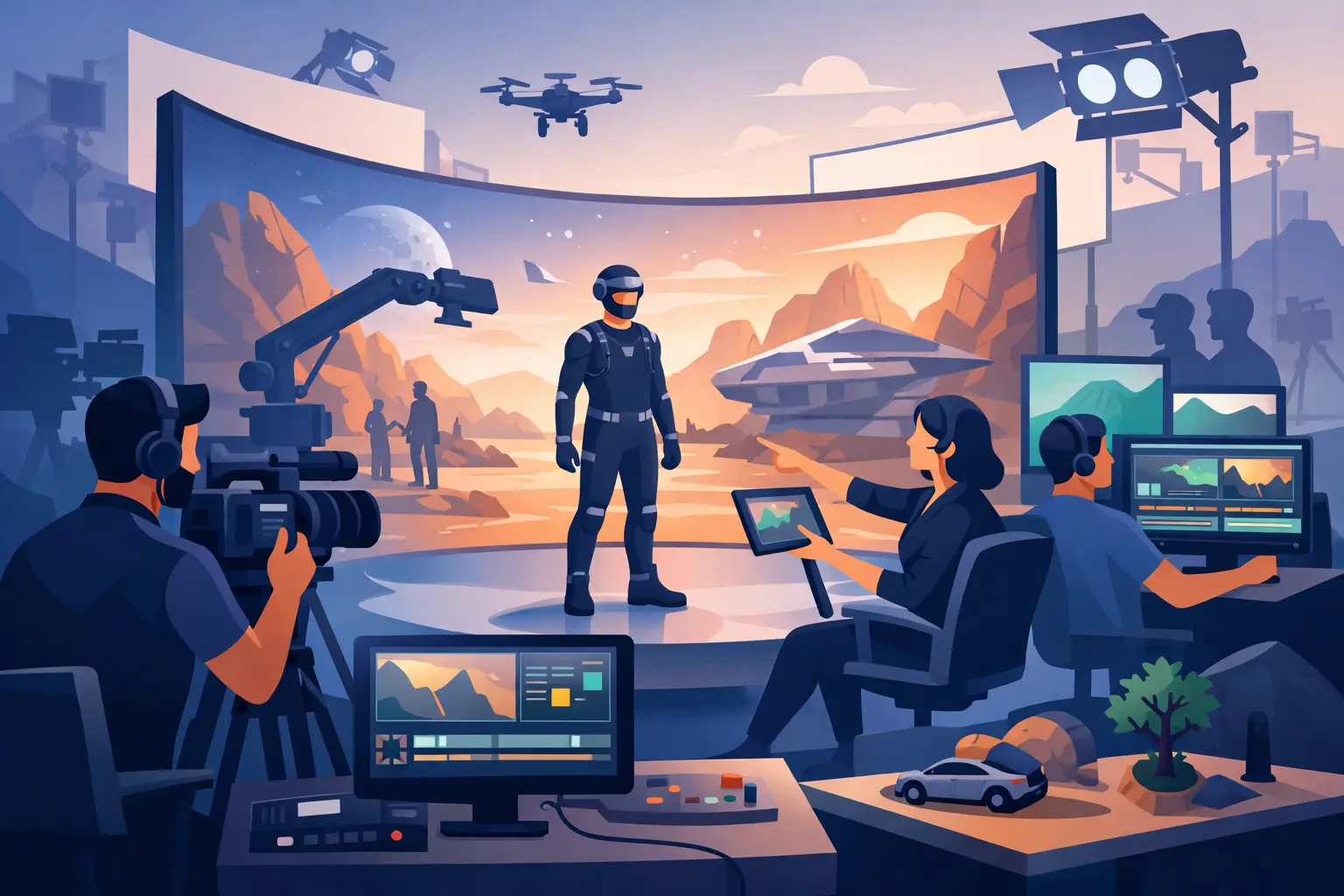
A location shoot can lose half a day before the first usable take. Permits, travel, weather, traffic, power access, changing light, and a client who needs one more setup all add friction. Virtual production changes that equation by bringing the environment into the studio, where the camera, lighting, crew, and creative direction stay under control.
For brands, agencies, filmmakers, and speakers, the value is not simply a striking LED background. It is the ability to produce more usable content in a defined window, with fewer moving parts and a clearer path from shoot to delivery.
What virtual production actually changes
Virtual production uses a large LED display to place talent, products, or vehicles in a digital environment while filming. That environment may be a city skyline, a branded graphic world, a conference stage, a luxury interior, a stylized landscape, or a carefully designed motion background. Unlike a flat backdrop added later, an LED wall produces real light on the subject and gives the camera something to capture in the moment.
That matters when the final image needs to feel grounded. Reflections appear on glass, polished surfaces, and a mirror floor. Color from the scene can influence the talent naturally. A presenter can react to charts, video, or branded motion graphics behind them instead of delivering lines into an empty green screen.
For high-end narrative work, the setup can include real-time camera tracking. As the camera moves, the perspective on the LED wall changes to create accurate parallax. This is the technique often associated with virtual sets in film and television. For commercial content, social video, interviews, and presentations, the right approach may be simpler: a locked or controlled camera setup with designed backgrounds, live playback, and production lighting. The goal is not to use every technical feature. The goal is to select the format that makes the content better and faster.
Virtual production is not just for film crews
The biggest misconception is that LED-based shooting only makes sense for major productions. In practice, it can be a highly efficient option for businesses that need a month of content from one session.
A founder can record short thought-leadership videos against several distinct branded environments without changing locations. A real estate team can shoot market updates with premium architectural visuals. A speaker can deliver a keynote, record a course module, and capture social cutdowns in one studio booking. An agency can give a campaign multiple visual directions without sending crew, talent, and client teams across Dubai.
The commercial advantage is consistency. If 25 short videos need the same visual standard, the studio can control the framing, sound, lighting, and environment across every take. That reduces the familiar problem of content that feels polished in the first video and improvised by the fifth.
It also supports speed. When the workflow includes shooting, edit selection, and defined short-form deliverables, content does not sit in a production queue for weeks. At PROS.CRTV, the production model is built around turning a focused shoot into ready-to-publish Reels within 24 hours, where the selected package and scope allow it.
The LED wall is only part of the result
An impressive screen does not automatically produce an impressive video. Virtual production works when the physical studio and the digital scene are planned together.
Start with the camera. Lens choice, camera distance, shutter settings, frame rate, and exposure all affect how the LED display appears on video. A screen can flicker, band, or create moire if the technical settings are not matched correctly. Production teams should test the intended camera configuration before rolling through a full shoot day.
Then consider lighting. The LED wall provides motivated color and ambient light, but it rarely replaces key lighting entirely. A controlled setup still needs intentional shaping on faces, products, and wardrobe. The best result usually comes from balancing the image on the wall with a lighting plan that keeps the subject clear, flattering, and separated from the background.
Audio deserves the same attention. A strong visual loses value immediately if dialogue sounds distant or inconsistent. For presentations, interviews, and social content, preset sound support and a quiet, managed recording environment can save more time than an elaborate backdrop ever will.
Finally, the scene itself has to support the message. A financial founder discussing a quarterly update may need restrained graphics and a credible business setting. A beauty campaign may benefit from bold color transitions, close-up product reflections, and a more graphic composition. The background should give the audience context, not compete with the person speaking.
When an LED setup is the right choice
Virtual production is particularly useful when a project needs visual variety but cannot afford the time, budget, or risk of multiple location shoots. It is also a strong fit when talent availability is limited, the shoot needs predictable timing, or the brand must maintain exact control over visual identity.
A 90+ m² studio with a large-format LED screen gives crews room to build a real production rhythm. There is space for camera movement, lighting, client monitoring, styling, and a crew of up to 20 people without forcing every department into the same corner. Add a mirror floor and the visual options expand further, especially for fashion, automotive-style product work, music performance, and premium brand films.
Still, it depends on the brief. If a story relies on a real public location, uncontrolled human activity, or the texture of a specific physical environment, shooting on location may remain the better creative decision. If the script requires a fully computer-generated world with complex interaction, post-production compositing may offer greater flexibility. An LED stage is most valuable when the environment needs to be visible, believable, and controllable during the shoot itself.
Plan the shoot around output, not hours
The most productive virtual production sessions begin with a deliverables plan. Booking four hours without deciding what must be captured can result in a beautiful test reel and too little finished content. Booking the same four hours around 20 to 30 planned short videos can create a focused production day with a measurable return.
Before the shoot, define four things: the core messages, the number of final formats, the visual environments required, and who has approval authority on set. That preparation keeps the day moving. It also prevents the LED wall from becoming a distraction, where too much time goes into debating backgrounds instead of capturing performances.
For social content, group scripts by framing and setup. Record all direct-to-camera hooks first, then move to product demonstrations, longer explanatory clips, and calls to action. Change the LED environment when it serves a new content pillar or campaign phase, not simply because another background is available.
For corporate presentations, load slides, videos, brand fonts, and playback files in advance. Build in a technical check for resolution, contrast, and camera readability. Fine text that looks sharp on a laptop may not read clearly once captured on camera. Clear visual hierarchy always performs better than dense slides behind a presenter.
A better production decision for fast-moving teams
The practical question is not whether virtual production looks futuristic. It is whether it reduces the distance between an idea and publishable content.
For a production company, that may mean an equipped studio available from 500 AED per hour, ready for its own crew and equipment. For a personal brand, it may mean one controlled shoot that produces weeks of polished Reels. For a corporate team, it may mean a presentation setup that records cleanly and generates social assets without coordinating separate vendors.
The best first step is simple: decide what the audience should receive after the shoot, then build the studio day backward from those deliverables. When the format, environment, crew, and edit plan are aligned, the LED wall stops being a novelty and becomes a production advantage.
Ready to shoot this?
Bring the brief to the stage — LED wall, mirror floor and a crew that turns ideas like this into finished content — same day on selected packages.
Book the studio