Rental Crew Versus Turnkey Production Compared
Compare rental crew versus turnkey production for Dubai shoots. Choose the right budget, control, crew, workflow, and delivery speed for your next video.
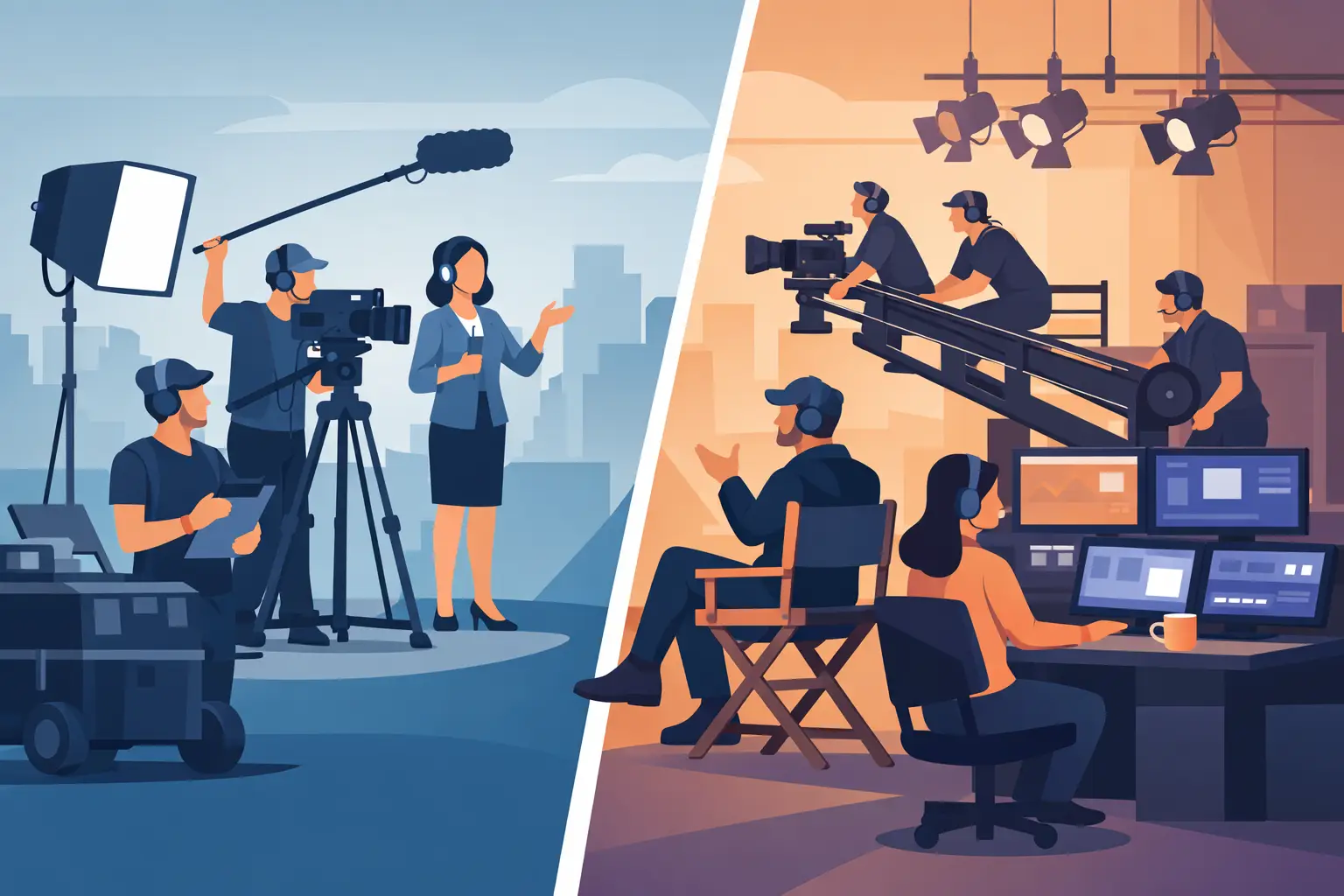
A shoot can look simple on a call sheet and become expensive the moment someone asks, “Who is bringing the lights, managing audio, directing talent, and cutting the Reels?” That is the real decision behind rental crew versus turnkey production. One route gives your team full control of the production day. The other gives you a defined system built to turn a shoot into usable content quickly.
For production companies and experienced videographers, studio rental can be the cleanest choice. For founders, marketing teams, speakers, and businesses that need polished content without coordinating five separate vendors, turnkey production is often the faster commercial move. Neither model is automatically better. The right choice depends on who owns the creative direction, how prepared the content is, and what needs to happen after the cameras stop rolling.
What a Rental Crew Model Actually Means
A rental crew model means you book the facility and operate the shoot with your own people. Your director, camera team, gaffer, sound recordist, producer, stylist, and editor remain under your control. The studio supplies the physical production environment according to the booking: space, core infrastructure, and agreed technical access.
This works well when your team already has a clear visual plan and a reliable workflow. A production company may need a large LED screen for a commercial scene, a mirror floor for a fashion setup, or a controlled space for a multi-camera interview. In those cases, the studio is a production asset, not a replacement for the crew.
The advantage is flexibility. Your team can work with its preferred camera package, lighting approach, on-set hierarchy, client approvals, and post-production pipeline. If the job requires a specialist - a motion-control operator, a food stylist, a cinematographer with a particular visual language - you can build the exact crew around the brief.
That freedom also creates responsibility. You manage call times, technical checks, crew coordination, media backup, talent flow, scripts, props, insurance requirements, edit scheduling, and delivery. A studio can be ready when you arrive, but it cannot solve a missing shot list or an editor who has not been booked.
When Rental Is the Stronger Choice
Rental is usually the right fit when the project is technically specific or creatively complex. Brand films, agency campaigns, music videos, product shoots, and high-control commercial productions often benefit from a dedicated crew because the workflow is already designed around the project.
It is also a smart choice when you have in-house production capability. If your marketing department has a content lead, videographer, editor, and established brand system, you may only need a professional room with prepared equipment and a strong visual backdrop. Paying for a full service team would duplicate resources you already have.
Budget can be more predictable as well - if your scope is genuinely controlled. A facility rental starting at 500 AED per hour gives experienced teams a clear base cost. But that number is only one line in the budget. Crew rates, equipment, transport, art direction, catering, overtime, edit rounds, music, and deliverables still need to be planned.
What Turnkey Production Changes
Turnkey production combines the studio, crew, capture plan, and post-production into one defined service. Instead of assembling the production piece by piece, you arrive with a business goal and leave with footage moving toward delivery.
For a founder, that might mean recording a month of social content in one focused session. For a corporate team, it could mean a presentation filmed against LED visuals, clean audio, a recorded keynote, and short edits cut for internal or public distribution. The value is not simply that someone else operates the camera. The value is that the shooting format, pace, and deliverables are built around publication.
A good turnkey team makes decisions before shoot day. How many videos are required? Which topics should be delivered as direct-to-camera Reels? What visuals belong on the LED screen? Which clips need vertical framing? What does the presenter need to say in the first three seconds? These choices prevent a common failure: producing hours of footage without enough finished assets to justify the day.
At PROS.CRTV, this model is designed around a production-ready Dubai space and a fast content workflow. The aim is direct: move from shoot to ready Reels within 24 hours when the selected format and approvals support that turnaround.
When Turnkey Is the Better Commercial Decision
Turnkey production is strongest when speed and output matter more than custom crew construction. A business launching a new service does not always need a large campaign set. It may need 25 or more useful short-form videos, a confident founder on camera, a polished background, and edits that can enter the publishing calendar immediately.
It is also the right answer when there is no internal producer. Many businesses underestimate how much coordination a shoot requires. Someone has to translate broad ideas into scripts, keep talent moving, manage retakes, protect the schedule, organize files, select the strongest takes, and deliver platform-ready cuts. With turnkey production, that operational layer is part of the purchase rather than an invisible task assigned to an already busy marketing manager.
Turnkey packages are particularly effective for recurring content. Once the format is established, the team can repeat it efficiently: talking-head insights, product explainers, podcast clips, founder commentary, speaker segments, and client education. This is not the best model for every creative job, but it is highly efficient for content that needs to perform consistently across social channels.
Rental Crew Versus Turnkey Production: The Real Trade-Offs
The difference is not “professional” versus “basic.” Both can produce premium work. The trade-off is control versus coordination.
With rental, you control every creative and technical variable. That is valuable when the brief requires precision, a proprietary workflow, or a client-facing production team. You can choose every person and every tool. The downside is that the schedule only moves as fast as your coordination allows.
With turnkey, the workflow is already organized around an outcome. You trade some open-ended customization for speed, defined scope, and fewer moving parts. That is valuable when content is a business function, not a film production exercise. The downside is that a turnkey package needs clear boundaries. If the concept expands into multiple locations, extensive art builds, complex visual effects, or a large cast, the package should be revised rather than stretched beyond its format.
Cost should be evaluated the same way. Rental can look less expensive at the booking stage, then rise as individual suppliers are added. Turnkey can look like a larger upfront commitment, but may cost less than separately booking a studio, operator, sound support, lighting, producer, and editor. Compare complete production cost and usable deliverables, not only the hourly rate.
Questions to Ask Before You Book
Start with the publishing requirement. If you need a polished brand film, ask what the creative treatment demands and whether your preferred crew can execute it. If you need a steady volume of founder-led videos, ask how many finished clips the shoot should create and when they must be ready.
Then assess your internal capacity. Do you have someone who can build a call sheet, lead the set, manage talent, and approve edits? Do you have scripts that can be recorded efficiently? Can your editor turn footage around fast enough for the campaign? If the answer is yes, studio rental gives you room to operate. If the answer is no, turnkey production removes risk before it reaches shoot day.
Finally, be honest about the decision-maker. A campaign with multiple stakeholders, brand approvals, and a detailed treatment may require a more custom production path. A founder recording expertise videos should not need three weeks of pre-production to produce a month of content. Match the process to the job, not to the most elaborate option on the menu.
Build the Production Around the Output
The strongest shoots begin with a finished-content target. Decide whether success means a hero video, a library of short clips, a recorded presentation, product visuals, or a complete campaign asset set. From there, choose the production model that protects that outcome.
Bring your crew when creative control is the product. Choose turnkey production when reliable output, prepared equipment, and fast delivery are the priority. The useful next step is simple: define what must be published after the shoot, then book the workflow built to get it there.
Ready to shoot this?
Bring the brief to the stage — LED wall, mirror floor and a crew that turns ideas like this into finished content — same day on selected packages.
Book the studio