What Is Virtual Production for Modern Video?
What is virtual production? See how LED walls, real-time environments, and planned workflows create faster, more flexible video shoots for brand teams.
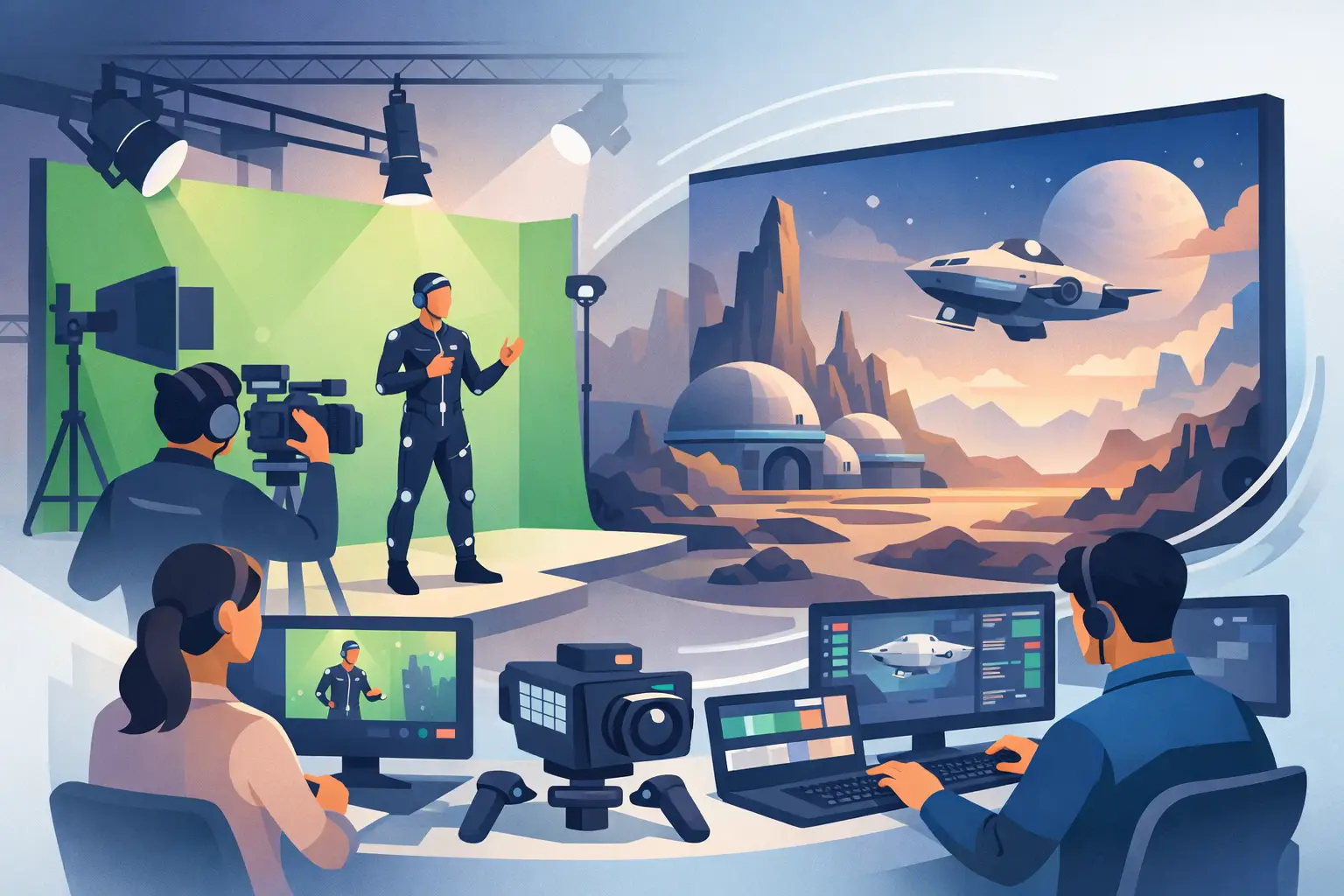
A founder delivers a product launch against a sunset skyline. A speaker presents quarterly results in a branded digital world. A car appears to move through a city without leaving the studio. The question, “what is virtual production,” matters because these scenes can now be created in-camera, with talent, camera movement, lighting, and background working together on the day of the shoot.
Virtual production is not a filter added after filming. It is a production method that uses real-time computer-generated environments, usually displayed on a large LED wall, to create a final or near-final background while the camera is rolling. Instead of filming a subject against green screen and building the scene later, the crew can see the environment live, frame it correctly, and capture natural reflections and lighting in the shot.
For brands and production teams, the value is practical: fewer moving parts, faster approvals, stronger visual control, and content that can be ready for editing as soon as the shoot wraps. It does not replace every location shoot or every VFX workflow. It gives teams another controlled, high-impact option when speed, consistency, and visual scale matter.
What Is Virtual Production, Exactly?
At its core, virtual production brings three systems into one set: an LED display, a real-time graphics engine, and a camera tracking workflow. The LED wall shows a digital location, branded graphic world, motion design, or pre-recorded plate. As the camera changes angle, the environment can shift with the correct perspective, making the image feel dimensional rather than flat.
That camera-aware perspective is one of the major differences between placing a video on a screen behind a presenter and building a true virtual-production scene. A simple display can still be highly effective for presentations, interviews, podcasts, music content, and social clips. Full virtual production adds tracking and real-time rendering when the creative requires parallax, moving camera shots, or an environment that responds precisely to the lens position.
The technology is often associated with large film productions, but the commercial use case is much broader. A business can use an LED stage to create a premium keynote background, shoot multiple campaign looks in one session, or produce short-form content that feels more expensive than a standard office setup. The scale of the setup should match the brief, not the other way around.
How a Virtual Production Shoot Works
The work starts before the camera arrives. The team defines what needs to exist on the LED wall: a virtual room, an abstract color world, a city backdrop, a product visual, presentation slides, or a sequence of campaign scenes. That material is then prepared to match the wall resolution, camera framing, aspect ratio, and intended motion.
On shoot day, the crew sets the talent, camera, lighting, and LED background as one image. This is a key operational advantage. The director, client, and presenter can evaluate the composition immediately rather than guessing how a green-screen replacement will look weeks later.
For tracked virtual environments, technical operators calibrate the camera and graphics system. The rendered background updates as the camera moves, preserving perspective. For fixed-camera content, the process is lighter: the LED wall can run a designed background or a presentation feed without needing full tracking. Both approaches can create strong results. The right choice depends on whether the scene needs cinematic camera movement or a controlled, repeatable content format.
A capable studio also plans for the details that affect the final frame. LED brightness needs to work with skin tones and wardrobe. Reflective surfaces can add depth, but they need deliberate lighting. Fine patterns and certain fabrics can cause moiré on camera. These are not reasons to avoid the format. They are reasons to treat the LED wall as part of the set, not as a screen switched on at the last minute.
Why Brands Are Using LED Stages Instead of Green Screen
Green screen remains useful. It is flexible, affordable, and often the best option when a scene will be heavily composited later. But it asks clients and talent to imagine the final result. It also creates more post-production dependency, especially when hair detail, transparent objects, reflections, or fast delivery are involved.
An LED stage solves a different problem. It gives the subject a real visual reference and gives the camera actual light from the environment. A warm desert scene can cast warm tones. A city night scene can create believable color in reflective materials. A mirror floor can extend the image and make an otherwise compact setup feel larger.
For speakers, founders, and social-first businesses, the biggest gain is often speed. A team can capture a direct-to-camera series, product moments, presentation clips, and alternate visual worlds in one session. Rather than booking multiple locations or waiting for complex compositing, the production can move from one prepared format to the next.
That does not mean every background should be virtual. A real location may be the better choice when authenticity depends on a specific place, such as a restaurant, factory, retail store, or live event. Virtual production works best when the location is a creative variable, not the story itself.
The Best Uses for Virtual Production
Virtual production is especially effective when content needs to look polished across many deliverables. A corporate team can record a leadership presentation against branded visuals, then cut the same session into announcement clips, training modules, and short social edits. A personal brand can create a month of reels with varied backgrounds while keeping the camera, audio, and lighting consistent.
It is also a strong fit for product campaigns. The LED wall can display motion graphics, close-up product textures, color systems, or lifestyle environments that would be expensive or impractical to build physically. For vehicles, fashion, beauty, technology, and premium services, that control can make a campaign feel more considered without requiring a large location footprint.
Production companies can use the format for music videos, commercials, interviews, stylized dialogue scenes, and inserts that need a precise backdrop. It is particularly useful when weather, travel, permits, or tight schedules create risk. A planned studio day is easier to control than a location day with ten external dependencies.
At PROS.CRTV, the 90+ m² Dubai studio is designed for this kind of practical production: a large LED screen, mirror floor, lighting, sound, and room for crews of up to 20. Teams can rent the prepared facility with their own crew or use a production package built around filming, editing, and fast social deliverables. The important point is not the equipment alone. It is having an environment where the creative and technical workflow are ready before the first take.
What Virtual Production Does Not Solve Automatically
The phrase can create unrealistic expectations if it is treated as a shortcut for weak planning. A high-resolution LED wall will not fix an unclear message, poor styling, or a presenter who has not rehearsed. It also cannot create unlimited visual complexity for every budget. Detailed real-time worlds, interactive environments, and advanced camera tracking require preparation, experienced operators, and the right hardware.
Content design matters as much as technology. If the goal is 25 short videos, plan the hooks, wardrobe changes, background variations, and call-to-action lines before the shoot. If the goal is a keynote, test every slide and video asset on the actual display. If the goal is a commercial, build a shot list around the capabilities of the virtual set rather than trying to force a location-based concept into a studio.
There are technical limits, too. Wide shots may reveal the edges of a wall if the set is not designed around them. Extremely bright scenes can affect exposure. LED refresh performance must be compatible with the camera settings. An experienced crew handles these decisions early, which is why a studio test or pre-production call can save substantial time on the day.
Planning a Shoot That Delivers More Content
The most efficient virtual-production shoots are format-led. Start with the outputs, not just the hero video. Decide whether you need vertical reels, horizontal presentation content, square ads, stills, or a mix. Then create a schedule that groups similar setups while preserving enough visual change to keep each piece distinct.
For a founder or expert, one four-hour session can include a polished introduction, educational clips, product or service explanations, objection-handling videos, and a presentation segment. The LED wall can shift the visual context between sections without rebuilding a physical set each time. That is how one shoot becomes a usable content library instead of a single polished video with no follow-up material.
Bring reference frames, final logos, approved brand colors, and presentation files in advance. Choose clothing that works with the planned environments, and avoid tiny high-contrast patterns unless they have been camera-tested. Most importantly, leave room for performance. When the background is already visible and the lighting is ready, talent can focus on delivery rather than imagining a scene that does not yet exist.
The strongest virtual-production work feels intentional, not technical for its own sake. Choose the environment that makes the message clearer, plan the formats your audience actually watches, and use the studio day to create content your team can publish while the campaign still has momentum.
Ready to shoot this?
Bring the brief to the stage — LED wall, mirror floor and a crew that turns ideas like this into finished content — same day on selected packages.
Book the studio